
Back to News

Best 2K Clear Coat Kits: What Solids, Mix Ratios, and Hardener Options Tell You Before You Buy

Every painter wants a high-gloss clear-coat finish that holds up under sun, road chemistry, and time. But the clear coat you pick determines whether you get that result or spend the next afternoon wet sanding out defects.
The best clear coat for basecoat application is not the one with the biggest name on the label. It is the one where the solids content, mix ratio, and hardener speed match the work sitting in your booth right now.
What Does Solids Content Tell You About a Clear Coat's Performance?
Solids content is the percentage of material that stays on the surface after the solvents evaporate. It is the most useful number on a clear coat's tech data sheet because it tells you how much protection and depth each coat delivers.
Medium Solids (MS): 35 to 45% Solids
More solvent in the mix means thinner film per coat, easier flow, and a more forgiving spray. You will need 2 to 3 coats to hit proper mil build (industry target: 2.0 mils dry film thickness for the clear layer).
MS clears are the workhorse for collision production shops where turnaround speed matters and painters may be clearing 8 to 10 jobs per week.
High Solids (HS): 50 to 66%+ Solids
Less solvent, thicker build per pass, stronger UV protection per coat. Two coats of a true HS clear can match or exceed the mil build of three MS coats.
This is the standard for restoration, custom work, and any job where depth of image (DOI), clarity, and long-term UV resistance matter more than speed.
What Most Product Pages Won't Tell You
Higher solid does not mean harder to spray. That depends on resin quality. A well-formulated 66% solids clear can flow like a medium solids product without forcing PSI adjustments. If the overspray melts into itself with each pass, the resin is doing its job. That is an engineering indicator, not a marketing number.
Painters shopping for an automotive clear coat in Florida or other high-humidity markets should lean toward an HS clear with a slow hardener. The higher resin content resists blushing and gloss loss in moisture-heavy air.
If you are sourcing a urethane clear coat in California, solids content matters for compliance too: higher solids means lower VOC, which helps meet SCAQMD district limits.
Revolt's lineup for this decision: The RC-357-66 Euro Clear sits at 66% solids with extreme UV resistance, built for custom and restoration. The RC-357-30 Glamour Clear runs 45% solids and is designed for high-end collision and production work.
What Is the Difference Between a 2:1, 4:1, and 4:1:1 Mix Ratio?
The mix ratio tells you how clear coat, hardener, and reducer relate in the cup. Understanding this is one of the first steps in learning how to paint a car with basecoat clearcoat, because the ratio affects coat count, flash time, and cure behavior.
2:1 (2 Parts Clear : 1 Part Hardener)
High solids, European-style formulation. Thicker build per coat. Two coats standard; if you stack three, add 5 to 10% urethane reducer to prevent solvent pop. Slower cure. Best for full vehicle jobs, custom, candy, and pearl finishes.
4:1 (4 Parts Clear : 1 Part Hardener)
Traditional American-style. More solvent in the system, easier flow, faster cure. Three coats recommended. More forgiving for painters building their clear coat technique. Strong fit for production collision and daily driver resprays.
4:1:1 (4 Parts Clear: 1 Part Hardener: 1 Part Reducer)
Reducer is built into the ratio. This is where an important distinction becomes practical:
- Reducer temperature (fast, medium, slow) controls how the surface stays open for leveling
- Hardener controls the chemical crosslink reaction that cures the film
They are not interchangeable functions. Confusing the two is one of the most common mistakes in clear coat application.
Hardener Speed by Shop Temperature
- Fast: Below 70°F, or spot and panel repairs needing quick cure
- Medium: 70 to 85°F, standard booth conditions, the most common pick
- Slow: Above 85°F, or full vehicle clears where the surface needs to stay open for flow
A complete basecoat clearcoat kit should match the hardener and reducer to the clear coat's ratio so the system works together. Mixing components from different brands risks adhesion issues and inconsistent cure.
If you are buying a 2K clear coat in California, confirm the kit's VOC rating matches your district's limits before you mix.
Revolt's lineup for this decision: The 357-88 Eco Clear at 4:1 for budget production work, and the 357-15 "The Flash" at 1:1 for small parts that cure in 15 minutes and buff in under 30.
What Should a Professional Clear Coat Kit Actually Include?
A kit worth buying includes three things: the clear coat, a matched hardener with temperature options (fast, medium, slow), and either an included reducer or documented compatibility with a urethane-grade reducer line.
Why Multiple Hardener Speeds Matter
A single-temp hardener locks you into a narrow window of shop conditions. Multiple speeds let you adapt to summer heat, winter cold, job size, and regional climate without switching brands.
Why Kit Volume Matters
Running out of clear mid-job is a defect waiting to happen. Kits measured in liters (5L, 6L, 7.5L) give professional painters enough material for full vehicle coverage without rationing the last coat.
Why Resin Origin Matters
European acrylic polyurethane resins, manufactured in facilities like those in Spain, carry a documented track record for UV stability, clarity, and gloss retention. This is where the finish either holds at 18 months or starts to yellow. It shows up in the work, not on the label.
Achieving a true high-gloss clear coat finish depends as much on resin quality and hardener chemistry as it does on spray technique. The best clear coat for basecoat systems is one where every component was formulated to work as a matched system, not assembled from three different suppliers.
Whether you are ordering an automotive clear coat in Florida where humidity runs year-round, or from a dry climate shop, having fast, medium, and slow hardener options in the same product line means you are covered.
Revolt ships urethane clear coat to California and every other state, with free shipping on orders over $500. Every Revolt 2K clear coat kit ships ready to spray, and California painters can text 757-438-0420 with VOC compliance questions before ordering.
For painters learning how to paint a car with basecoat clearcoat for the first time, the Glamour Clear's 4:1:1 ratio and single-temp hardener make it one of the most forgiving entry points in a professional-grade lineup.
Revolt's basecoat clearcoat kit options range from budget production clears to 66% high solids European formulations, all manufactured in Spain using top-shelf acrylic polyurethane resins by Custom Creative.
Ready to Match Your Clear Coat to Your Next Job?
Browse the full Revolt Clear Coat Collection, or text 757-438-0420 for product recommendations matched to your shop conditions. Need application guidance? Join the Revolt Auto Paint Facebook group for 24/7 tech support from working painters and the Revolt team. Free shipping on all orders over $500.
FAQs
What is a 2K clear coat, and why do professionals use it?
2K (two-component) clear coat mixes urethane resin with a chemical hardener before spraying. The hardener triggers a crosslink reaction that cures into a film far harder, more chemical-resistant, and more UV-stable than 1K alternatives. It is the industry standard for professional collision, restoration, and custom refinishing.
Can you use the same clear coat for collision repair and custom work?
You can, but the tradeoffs matter. A 45% medium solids clear at 4:1:1 is ideal for collision where speed and forgiving application are priorities. A 66% high solids clear at 2:1 builds more depth and UV protection for custom and restoration where the finish is the centerpiece.
What causes solvent pop, and how do you prevent it?
Solvent pop happens when trapped solvents escape through a surface that has already skinned over. Common causes: insufficient flash time between coats, coats applied too heavily, or hardener and reducer speed too fast for shop temperature. Fix: proper flash (10 to 15 minutes at 70°F), medium wet coats, and matching hardener speed to conditions.
How long should you wait before cutting and buffing the clear coat?
Most 2K clears are ready for cut and buff after 12 to 24 hours of air drying, or after a bake cycle at 140°F for 30 minutes. Some painters wait 24 to 48 hours before aggressive wet sanding for full solvent release. A quality HS clear should still buff well even weeks after application.
Does a clear coat protect candy paint from UV fading?
Yes, but the clear must have strong UV absorbers. Candy finishes use transparent dyes that are inherently UV-sensitive, no matter the brand, they are prone to fading over time. A high-solids clear with extreme UV resistance is recommended over candy to extend color life. Revolt recommends the TopShelf Clear for the strongest resistance, or the 357-66 Euro Clear specifically for candy and pearl systems.
Is buying a complete kit better than sourcing components separately?
Yes. A matched kit ensures the clear, hardener, and reducer work as a single system. Mixing components from different brands risks compatibility problems: adhesion failure, inconsistent cure, or finish defects that only surface after the vehicle leaves the shop.
More News & Guides

Auto Body Painting Supplies by Job Stage: What to Buy for Prep, Paint, and Refinish Work
Buy auto body painting supplies by the job stage, not the shelf. A clean finish needs prep, masking, compatible mixing,...
Read Article
How Much Reducer Does Your Paint Need? Reading Ratios Before You Mix
Your paint needs the amount of reducer listed in that coating’s mixing instructions. First, check which product each number represents....
Read Article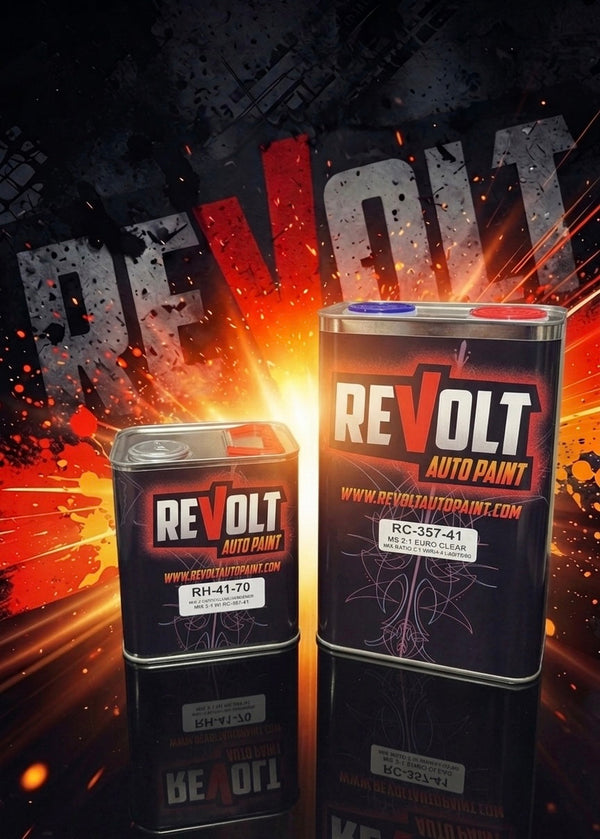
Epoxy or DTM: Which Primer Belongs on Your Restoration Build?
Epoxy primer and DTM primer can both be used during a restoration, but they do not always perform the same...
Read Article